


A Neurocognitive Coherence Framework for Emotional Regulation, Trauma Integration, and Leadership Stability
Sebastian S.Bejan
Leadership & Mind Discipline Mentor | Corporate Trainer | EQ and NLP Life Coach | CB Therapist | Mastering the Mind & Spirit | High Performance Life Coach | Spiritual & Psychological Leadership Coach
Enhanced Wellness Solutions
Abstract
Emotional reactivity in clinical and leadership contexts is often described as impulsive or instinctive. However, contemporary neuroscience, cognitive appraisal theory, trauma research, and autonomic regulation models demonstrate that emotional responses follow structured interpretive and physiological processes.
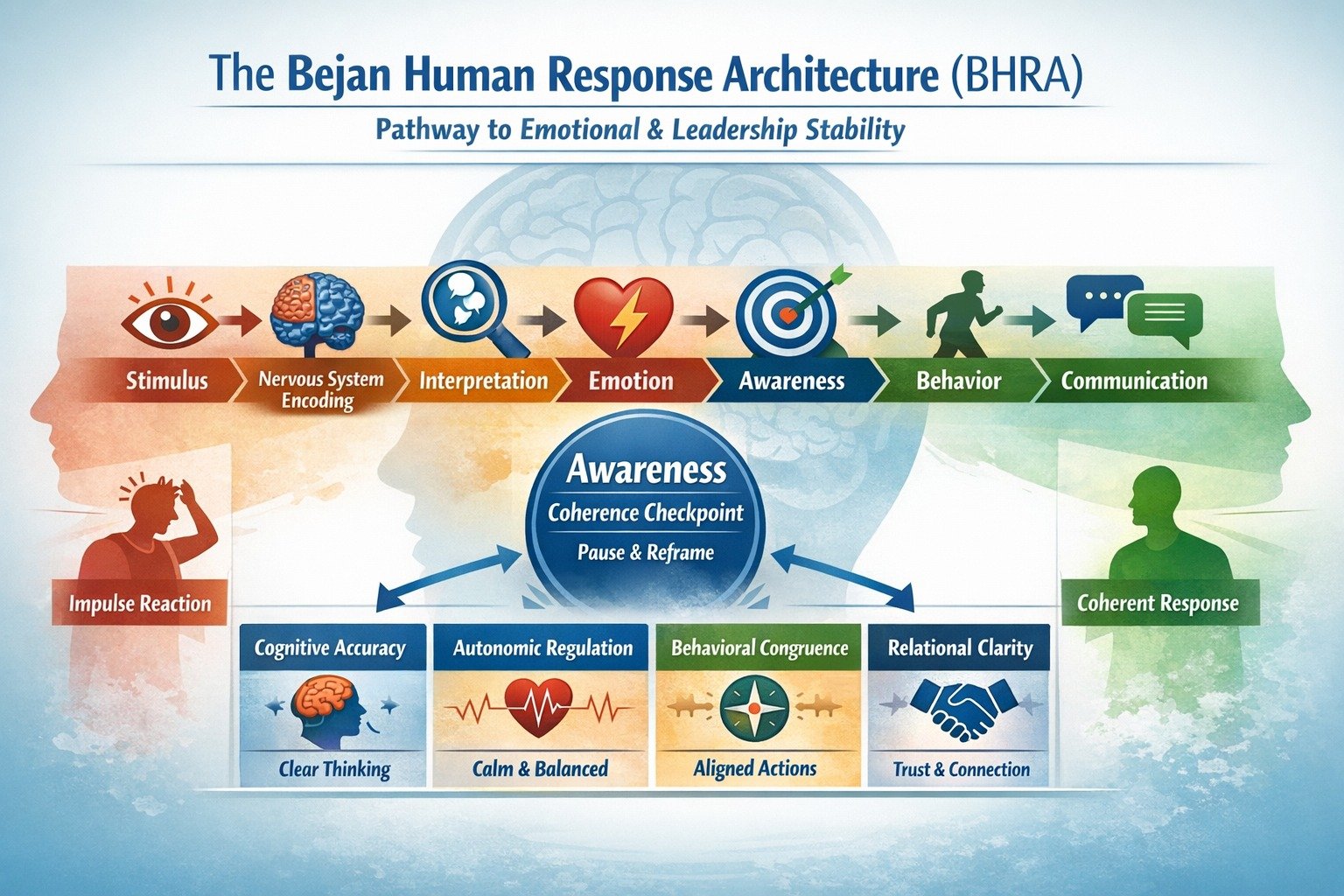
This article presents the Bejan Human Response Architecture (BHRA) — a coherence-based neurocognitive framework describing the structured progression:
Stimulus → Nervous System Encoding → Interpretation → Emotion → Awareness → Behavior → Communication
The BHRA conceptualizes awareness as a regulatory checkpoint that evaluates interpretive accuracy against present-moment reality and chosen identity. Integrating cognitive appraisal theory (Richard Lazarus), dual-pathway emotional processing (Joseph LeDoux), affect labeling research (Matthew Lieberman), cognitive control models (Kevin Ochsner & James Gross), and Stephen Porges’ polyvagal theory, the BHRA offers a bidirectional regulatory model applicable to trauma-sensitive intervention and high-performance leadership development.
Coherence is defined as a multidimensional construct measurable across cognitive, autonomic, behavioral, and relational domains. The model proposes a two-phase progression: increased tolerance precedes reduction of suffering. Implications for staged regulation and performance stabilization are discussed.
1. Introduction
Human emotional responses are frequently perceived as immediate reactions to external events. Yet neuroscience demonstrates that emotional activation follows structured appraisal and autonomic processes. Emotion is not random; it reflects encoded meaning within the nervous system.
The BHRA formalizes this structure into a coherence-based architecture integrating:
The model proposes that suffering and instability arise from breakdowns in coherence between stimulus, interpretation, physiology, and chosen identity. Restoration of coherence increases tolerance, reduces suffering over time, and enhances performance.
2.Theoretical Foundations
2.1 Cognitive Appraisal and Meaning Assignment
Cognitive appraisal theory, articulated by Richard Lazarus, posits that emotion arises from interpretation rather than stimulus alone. Primary and secondary appraisals determine perceived threat, relevance, and coping potential.
Emotion follows meaning assignment.
2.2 Dual-Pathway Emotional Processing
Joseph LeDoux demonstrated that emotional processing occurs via:
Emotion may precede conscious thought, but it does not precede implicit meaning.
2.3 Polyvagal Theory and Neuroception
Stephen Porges introduced polyvagal theory, emphasizing autonomic regulation through neuroception — the nervous system’s implicit detection of safety or threat.
Trauma alters baseline neuroception, biasing interpretation toward threat.
Within BHRA, nervous system encoding precedes conscious interpretation.
2.4 Cognitive Control and Affect Labeling
Research by Kevin Ochsner and James Gross demonstrates that cognitive reappraisal strengthens prefrontal modulation of amygdala activation.
Matthew Lieberman showed that affect labeling reduces limbic activation and increases regulatory stability.
These findings support awareness as an active regulatory process.
3.The Bejan Human Response Architecture
The BHRA proposes the following structured progression:
Stimulus → Nervous System Encoding → Interpretation → Emotion → Awareness → Behavior → Communication
3.1 Stimulus
External events or internal cues (memory, sensation, anticipation).
Stimulus alone does not generate emotion.
3.2 Nervous System Encoding
Implicit memory, trauma patterns, conditioning, and prior experiences activate below awareness.
This stage shapes interpretation before conscious cognition emerges.
3.3 Interpretation
Meaning is assigned to the stimulus based on encoding.
Under trauma or stress, interpretation may become distorted.
3.4 Emotion
Emotion functions as a physiological signal indicating that meaning has been assigned.
It reflects autonomic activation — not raw stimulus exposure.
3.5 Awareness: The Coherence Checkpoint
Awareness evaluates interpretation against:
Awareness does not suppress emotion.
It recalibrates meaning.
3.6 Behavior and Communication
Behavior reflects regulatory success or failure at the awareness stage.
Communication externalizes internal coherence — or misalignment.
Leadership instability often reflects coherence breakdown at this checkpoint.
4. Bidirectional Regulation Model
The BHRA operates bidirectionally:
Under High Autonomic Load
Bottom-up stabilization must precede reinterpretation:
5. Operational Definition of Coherence
Coherence is defined as a measurable, multidimensional construct reflected across:
Coherence is not abstract. It is observable and trainable.
6. Developmental Progression of Awareness
Awareness evolves across four layers:
This progression aligns with trauma-informed therapeutic sequencing.
7. The Tolerance → Reduction Model
The BHRA predicts a two-phase transformation:
Phase 1: Increased Tolerance
Tolerance increases before symptoms decrease.
Phase 2: Reduced Suffering
Suffering reduction follows sustained coherence.
8. Applications
8.1 Trauma Integration
BHRA supports:
8.2 Leadership Performance
BHRA enhances:
Performance becomes a byproduct of coherence.
For executive leadership development, this provides a measurable emotional stability framework.
9. Limitations and Future Research
Future empirical studies should:
Empirical validation would strengthen clinical and organizational adoption.
10.Conclusion
The Bejan Human Response Architecture proposes that suffering and instability arise from breakdowns in coherence between nervous system state, interpretation, emotional signaling, and chosen identity.
Awareness functions as the central coherence-restoration mechanism.By integrating bottom-up stabilization with top-down recalibration, BHRA offers a unified framework for:
The Bejan Human Response Architecture (BHRA) explains, in simple terms, how a human reaction is formed and how it can be changed. It shows that we do not react directly to events — we react to the meaning of our nervous system and mind assign to those events.
First, something happens (a stimulus). Then our nervous system quickly scans it for safety or threat based on past experiences. After that, we interpret what it means, and that interpretation creates emotion.
Awareness acts as a checkpoint where we can pause, examine whether our interpretation is accurate, and decide how we want to respond based on our values and identity. When awareness is active, our behavior and communication become more stable and aligned. When it is not, we react automatically.
In short, BHRA teaches that emotional stability and strong leadership are not about suppressing feelings, but about understanding the structure of how reactions are built and restoring coherence before we act.
Coherence increases tolerance.
Tolerance precedes reduction of suffering.
Sustained coherence enhances performance.

Enhanced Wellness Solutions delivers holistic mental health and wellness services, combining expert care with compassionate support to nurture well-being in individuals and organizations alike.
© Copyright 2026 Enhanced Wellness Solutions – All Rights Reserved.
Enhanced Wellness Solutions
Typically replies within minutes
How can we support you today?
WhatsApp Us
🟢 Online | Privacy policy
Least Discuss