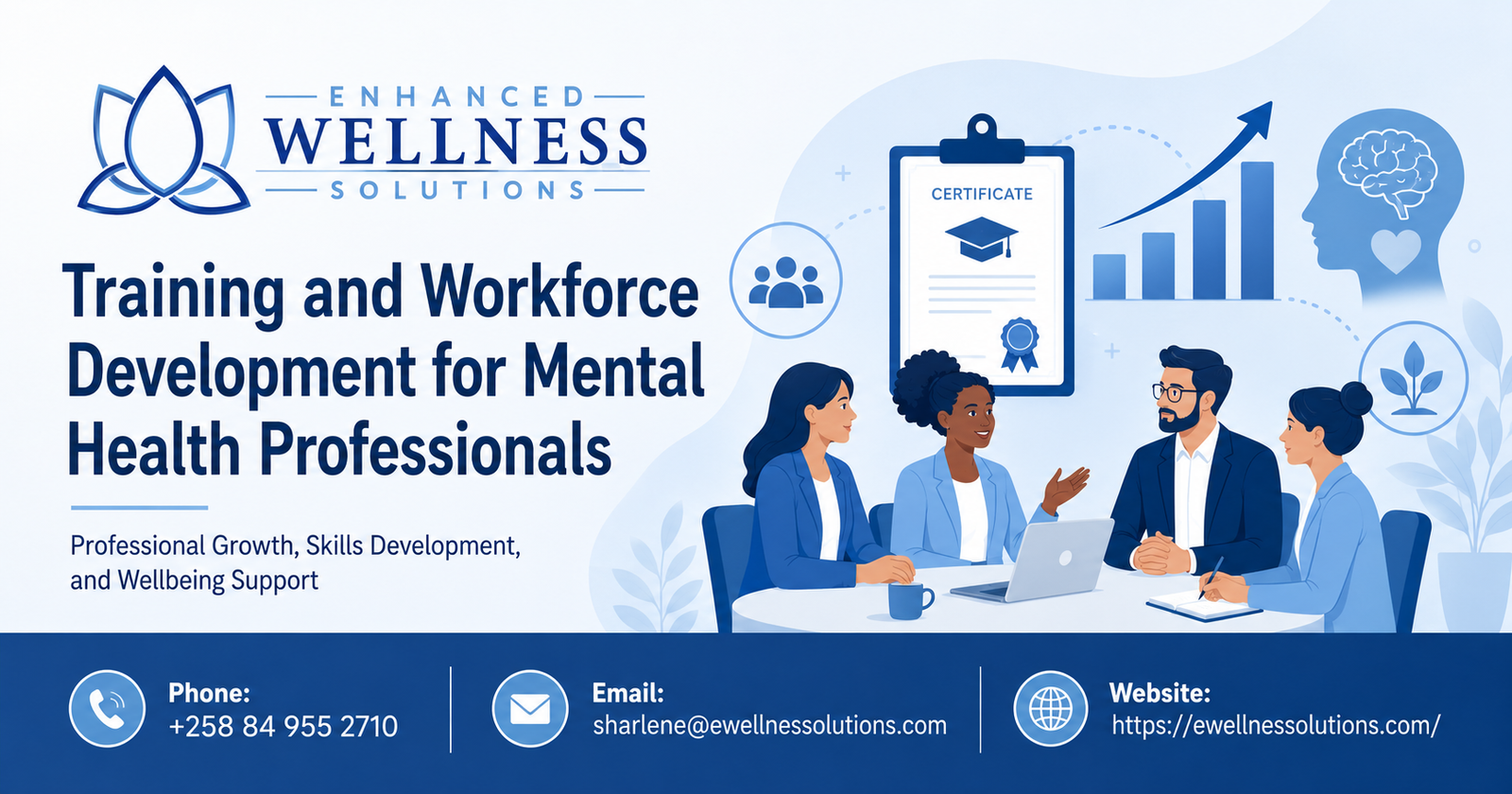
Short Answer: Training and Workforce Development for Mental Health Professionals helps counselors, therapists, coaches, social workers, HR teams, and care providers strengthen their skills, improve ethical practice, support clients more effectively, and respond to modern mental health needs with confidence. In Maputo and nearby areas, Enhanced Wellness Solutions supports professional growth through evidence-based, human-centered mental health services, workplace wellness support, psychometric assessments, psychotherapy, coaching, CBT-informed care, and team development programs.
| Key Topic | Direct Answer |
|---|---|
| What is mental health workforce development? | It is the structured process of improving the skills, knowledge, ethics, supervision, and care capacity of mental health professionals. |
| Who needs this training? | Therapists, counselors, psychologists, coaches, social workers, EAP teams, HR leaders, community workers, and wellbeing professionals. |
| Why does it matter? | It improves care quality, client safety, professional confidence, burnout prevention, and service consistency. |
| What skills are covered? | Communication, assessment, trauma-informed care, CBT principles, ethics, referral skills, case planning, and workplace mental health support. |
| Who can help in Maputo? | Enhanced Wellness Solutions provides Professional Mental health services in Maputo and nearby areas with a compassionate, evidence-based approach. |
Mental health needs are growing in workplaces, schools, families, and communities. At the same time, professionals who support emotional wellbeing are expected to respond with skill, care, ethics, and cultural sensitivity. This is why Training and Workforce Development for Mental Health Professionals is no longer optional. It is an important part of building stronger care systems and safer support environments.
Mental health professionals need more than academic knowledge. They also need practical communication skills, assessment confidence, ethical awareness, trauma-informed thinking, workplace wellness knowledge, and the ability to support people from different backgrounds. In addition, they need systems that protect their own wellbeing, because burnout can affect both professionals and the people they serve.
For organizations in Maputo and nearby areas, workforce development can help improve service quality, team confidence, and mental health outcomes. It can support therapists, coaches, HR teams, supervisors, school staff, community program leaders, and employee assistance teams.
At Enhanced Wellness Solutions, we understand that mental health work is deeply human. Our approach blends professional insight, evidence-based methods, compassion, and practical growth. We provide Professional Mental health services in Maputo and surrounding areas for individuals, teams, and organizations that want stronger support, clearer direction, and healthier systems.
Training and Workforce Development for Mental Health Professionals refers to structured learning, supervision, skill-building, and professional support designed to improve the quality of mental health care. It helps professionals grow in both knowledge and practice.
This development may include clinical skills, ethical decision-making, communication techniques, assessment methods, case management, referral pathways, crisis response awareness, workplace wellbeing, trauma-informed care, and ongoing reflective practice.
In simple terms, workforce development helps mental health professionals become more prepared, confident, and effective.
It is useful for many roles, including:
However, training is not only about learning new tools. It is also about improving judgment. Mental health professionals often work with sensitive issues such as stress, anxiety, trauma, grief, workplace pressure, relationship concerns, burnout, low confidence, and emotional overwhelm. Therefore, they must know when to support, when to refer, and how to work within ethical boundaries.
Good workforce development helps create that balance.
Mental health care depends on people. A strong mental health workforce can make services safer, more consistent, and more helpful. When professionals are well trained, they can listen better, assess needs more clearly, respond with empathy, and guide clients toward appropriate support.
Workforce development matters because mental health needs are complex. A person may come for stress support, but deeper issues may also appear during the conversation. A workplace may ask for team support, but the real challenge may involve burnout, conflict, poor communication, or leadership strain. A client may need coaching, but they may also need psychotherapy or a referral to specialized care.
Without proper training, professionals may miss important signs or work outside their scope. On the other hand, with ongoing development, they can respond more responsibly.
Training also improves confidence. Many professionals want to help, but they may feel unsure when facing difficult conversations. Structured training gives them tools, language, and frameworks. As a result, they can provide support in a more grounded and professional way.
For organizations, mental health workforce development can also improve staff wellbeing. It can reduce confusion, build stronger support systems, and create a healthier culture around emotional care.
Across communities and workplaces, people are seeking more emotional support, psychological guidance, and wellbeing services. Stress, burnout, uncertainty, family pressure, workplace demands, and social challenges can affect daily functioning. Because of this, skilled mental health professionals are needed in many settings.
However, demand alone is not enough. Professionals must also be prepared.
A strong mental health workforce needs training in evidence-based methods, but also in real-world human connection. People do not only need techniques. They need to feel heard, respected, and supported. Therefore, professional development must include both technical knowledge and compassionate practice.
This is especially important in workplaces. Employers increasingly recognize that mental wellbeing affects productivity, communication, teamwork, staff retention, and leadership performance. Employee Assistance Programs, team mentorship, group support, and workplace wellbeing services can help, but they must be delivered with care and professionalism.
Enhanced Wellness Solutions supports this need by offering human-centered mental health and workplace wellness services in Maputo and nearby areas. Our work is grounded in compassion, ethics, and practical transformation.
Training and Workforce Development for Mental Health Professionals has several important goals. First, it improves care quality. Second, it supports professional growth. Third, it helps organizations build stronger mental health systems. Finally, it protects both clients and providers through ethical, structured practice.
The main goals include:
These goals matter because mental health work can be sensitive. Professionals need to understand not only what to say, but also how to listen, when to pause, and when to involve another provider.
Workforce development also encourages lifelong learning. Mental health professionals should continue growing throughout their careers. New challenges, new client needs, and changing workplace realities require continuous improvement.
Mental health professionals need a wide range of skills. Some are clinical. Others are relational, ethical, or organizational. Together, these skills help professionals provide more effective support.
Strong communication is the foundation of mental health work. Professionals must know how to listen without rushing, ask helpful questions, and create a safe space for the client or employee.
Active listening includes attention, empathy, reflection, and nonjudgmental presence. It helps the person feel understood. It also helps the professional gather important information.
Good communication is especially important in workplace settings, where employees may worry about confidentiality, judgment, or consequences. A trained professional knows how to create trust while maintaining boundaries.
Ethics are essential in mental health care. Professionals need to understand confidentiality, informed consent, scope of practice, referral limits, dual relationships, documentation, and professional responsibility.
Workforce development helps professionals make better ethical decisions. It also helps prevent harm. For example, a coach should know when a client’s needs require psychotherapy. A workplace support provider should understand confidentiality limits. A therapist should know when additional referral or supervision is needed.
Clear boundaries protect everyone involved.
Mental health professionals need to understand what a person is experiencing. This does not always mean formal diagnosis. In many settings, it means careful listening, structured questioning, observation, and understanding the client’s goals or risks.
Training can help professionals recognize signs of stress, burnout, trauma responses, emotional distress, workplace conflict, and functional challenges. It can also help them identify when someone may need specialized care.
Enhanced Wellness Solutions offers psychometric assessments and professional support services that can help individuals and organizations better understand strengths, needs, and development areas.
Trauma-informed care means recognizing that past or present distress can affect behavior, emotions, relationships, and trust. It does not force people to share painful experiences. Instead, it creates safety, choice, collaboration, and respect.
Mental health professionals who understand trauma-informed care are better prepared to avoid judgment and reduce re-traumatization. They can support clients with patience and sensitivity.
This approach is useful not only in therapy, but also in workplaces, schools, community programs, and group support settings.
Cognitive Behavioural Therapy, often called CBT, helps people understand the connection between thoughts, emotions, and behaviors. While only qualified professionals should use CBT as a clinical intervention within their scope, many mental health and wellbeing professionals can benefit from understanding CBT-informed principles.
Training in CBT-informed thinking can help professionals support clearer problem-solving, emotional awareness, coping skills, and goal setting.
Enhanced Wellness Solutions includes Cognitive Behavioural Therapy as part of its professional mental health services, helping clients explore practical tools for emotional growth and personal development.
Mental health support must be culturally aware. People’s beliefs, family systems, workplace norms, language, community expectations, and life experiences influence how they understand mental wellbeing.
In Maputo and nearby areas, professionals need to listen with respect for local realities. They must avoid one-size-fits-all solutions. Instead, they should adapt communication and support to the person, family, team, or organization they are serving.
Cultural sensitivity helps create trust. It also improves the quality of care.
Mental health professionals are increasingly needed in workplace settings. They may support employees, managers, HR teams, and leadership groups. Therefore, they need skills in workplace stress, burnout prevention, conflict support, team communication, and employee wellbeing.
Training may include:
Enhanced Wellness Solutions provides Employee Assistance Programs, team mentorship, and group support services for organizations that want healthier and more supportive workplaces.
Training improves client care by helping professionals respond with more confidence, clarity, and responsibility. When professionals are well trained, they can support clients in a more structured way.
For example, a trained professional may be better able to identify the difference between everyday stress and a more serious concern that needs additional support. They may also know how to ask helpful questions, document sessions, create realistic goals, and refer when needed.
This improves the client experience.
Clients often seek support when they feel vulnerable. They need to feel safe, respected, and understood. Professional development helps providers create that environment.
Better training also reduces inconsistency. If each team member uses a different approach, the quality of care may vary. Workforce development creates shared standards, shared language, and shared expectations.
As a result, organizations can provide more reliable support.
Mental health professionals give emotional energy every day. They listen to difficult stories, support people through distress, and often carry high responsibility. Without support, they can experience burnout, compassion fatigue, or emotional exhaustion.
Workforce development can help reduce burnout by teaching professionals how to manage boundaries, use supervision, practice self-awareness, and recognize early signs of stress.
Important burnout prevention strategies include:
This matters because a healthy professional is better able to support others. Workforce development should not only focus on client care. It should also protect the wellbeing of the workforce itself.
Employee Assistance Programs, also known as EAPs, help employees access support for stress, workplace challenges, emotional concerns, family issues, and other wellbeing needs. However, EAP teams must be trained to respond appropriately and ethically.
Training for EAP teams can include:
Enhanced Wellness Solutions provides EAP services in Maputo and nearby areas. Our approach helps organizations support employees with compassion, professionalism, and respect.
Professional life coaches, NLP practitioners, and mentors can play a positive role in personal growth, workplace development, and goal setting. However, coaching is not the same as therapy. This difference must be clear.
Training helps coaches and mentors understand their scope. It teaches them how to support goals, motivation, communication, and self-development while recognizing when a client may need mental health care from a qualified provider.
This protects clients and strengthens professional trust.
Enhanced Wellness Solutions offers NLP and professional life coaching as part of a broader human-centered approach. Our goal is to help people gain clarity, build confidence, and move toward meaningful growth while respecting ethical limits.
HR leaders and managers are often the first to notice employee stress, conflict, burnout, or performance changes. They are not expected to become therapists. However, they can benefit from mental health awareness training.
Workforce development for HR and managers can help them:
This type of training can improve workplace culture. It can also help employees feel supported before problems become more serious.
Group support can be powerful. People often feel less alone when they hear from others with similar experiences. However, group facilitation requires skill. A poorly managed group can become unsafe or unhelpful.
Training helps facilitators create structure, set group expectations, manage sensitive conversations, and respond to emotional moments. It also helps facilitators maintain boundaries and know when someone may need individual support.
Enhanced Wellness Solutions provides team mentorship and group support services that help people learn, connect, and grow in a guided environment.
Psychometric assessments can support workforce development by helping individuals and teams understand strengths, preferences, behaviors, and development needs. When used ethically, assessments can improve self-awareness and guide growth.
In workplace and professional development settings, assessments may support:
However, assessments should be used responsibly. They should not be used to label or limit people. Instead, they should help open useful conversations.
Enhanced Wellness Solutions offers psychometric assessments as part of its services, supporting individuals and organizations with insight-driven development.
Evidence-based training means using methods that are grounded in professional knowledge, research-informed practice, and ethical care. In mental health, this matters because people deserve support that is thoughtful, safe, and responsible.
Evidence-based training does not remove the human side of care. Instead, it strengthens it. It gives professionals reliable tools while allowing them to respond with empathy and flexibility.
For example, CBT-informed approaches, structured assessments, reflective supervision, and trauma-informed care can all help professionals work more effectively.
At Enhanced Wellness Solutions, we blend evidence-based methods with compassion and personalized support. Our guiding belief is simple: healing and human potential grow best in environments of trust, clarity, and care.
Enhanced Wellness Solutions provides Professional Mental health services in Maputo and nearby areas. Our work supports individuals, professionals, teams, and organizations that want better emotional wellbeing, stronger performance, and healthier growth.
Founded by Sharlene Raston and Bejan Stefan Sebastian, Enhanced Wellness Solutions is built around a compassionate, evidence-based, and human-centered approach. Our brand promise, “Where Human Potential Meets Healing,” reflects our commitment to both personal transformation and professional care.
Our services include:
For mental health professionals and organizations, we can support development through training-oriented services, team support, coaching, reflective growth, and wellbeing-focused programs. We help people understand themselves, communicate better, manage stress, and build more supportive systems.
If you are looking for Professional Mental health services in Maputo, Enhanced Wellness Solutions is a strong local choice.
A healthier mental health workforce benefits everyone. It benefits clients, professionals, workplaces, families, and communities. When professionals are supported, trained, and guided, they can provide better care. When organizations invest in workforce development, they create stronger support systems.
In Maputo and nearby areas, this is especially important as more individuals and workplaces recognize the value of emotional wellbeing. Mental health support should be accessible, respectful, and grounded in professional care.
Workforce development can help create that future. It can improve service quality, reduce stigma, increase confidence, and support ethical practice.
Enhanced Wellness Solutions is proud to contribute to this work. Through our professional services, we help individuals and teams move toward clarity, healing, resilience, and growth.
Organizations that want to support mental health professionals can begin with simple, structured steps.
First, assess current skills and gaps. This may include reviewing staff confidence, service demands, supervision needs, and training priorities.
Next, create a development plan. The plan should include training topics, timelines, support systems, and expected outcomes.
Then, provide regular learning opportunities. One-time training can help, but ongoing development creates stronger results.
After that, support supervision and reflection. Professionals need space to discuss challenges and learn from practice.
Finally, protect staff wellbeing. Workforce development should include burnout prevention, emotional support, and healthy workload planning.
These steps help create a stronger, safer, and more sustainable mental health workforce.
You should contact Enhanced Wellness Solutions if you need Professional Mental health services in Maputo or nearby areas. We support individuals, professionals, teams, and organizations with compassionate and practical services.
You may benefit from our support if:
Enhanced Wellness Solutions provides personalized care and professional support. Our goal is not to promise quick fixes. Instead, we help people and organizations move forward with insight, care, and realistic tools.
To learn more, contact Enhanced Wellness Solutions at +258 84 95527 10.
Training and Workforce Development for Mental Health Professionals is essential for stronger care, safer practice, and healthier communities. It helps professionals improve communication, ethics, assessment, trauma-informed care, workplace support, and self-care. It also helps organizations build better systems for emotional wellbeing.
For Maputo and nearby areas, this work is especially valuable. Skilled and supported mental health professionals can improve client care, workplace wellness, and community support.
Enhanced Wellness Solutions offers Professional Mental health services in Maputo with a compassionate, evidence-based, and human-centered approach. Through psychotherapy, psychometric assessments, EAP services, coaching, CBT, team mentorship, and group support, we help individuals and organizations grow with clarity and care.
If you need professional mental health support in Maputo or nearby areas, Enhanced Wellness Solutions is here to help you take the next step toward healing, growth, and human potential.
Training and Workforce Development for Mental Health Professionals is the process of improving the skills, ethics, knowledge, and confidence of people who provide mental health or wellbeing support. It may include communication training, assessment skills, CBT-informed learning, trauma-informed care, supervision, and workplace mental health education.
Workforce development is important because mental health professionals need ongoing training to provide safe, ethical, and effective support. It helps improve care quality, reduce burnout, strengthen confidence, and create better outcomes for individuals and organizations.
Counselors, therapists, coaches, HR leaders, EAP teams, social workers, school staff, group facilitators, mentors, and community support workers can benefit from mental health workforce training. It is also useful for organizations that want stronger workplace wellbeing systems.
Yes. Enhanced Wellness Solutions provides Professional Mental health services in Maputo and nearby areas. Services include psychotherapy, psychometric assessments, Employee Assistance Programs, NLP and professional life coaching, team mentorship, group support, and Cognitive Behavioural Therapy.
You should contact Enhanced Wellness Solutions if you need mental health support, workplace wellness services, psychotherapy, CBT-informed care, coaching, assessments, EAP support, team mentorship, or group support in Maputo and nearby areas. Call +258 84 95527 10 to learn more.
Contact Us for Your Professional Mental health services in Mozambique
Company Name: Enhanced Wellness Solutions
Address: 135, Eça de Queiroz Street, Coop Neighbourhood, Maputo, Mozambique
Phone: +258 84 95527 10
Visit Our Website: Click Here
Google Business Profile

Enhanced Wellness Solutions delivers holistic mental health and wellness services, combining expert care with compassionate support to nurture well-being in individuals and organizations alike.
© Copyright 2026 Enhanced Wellness Solutions – All Rights Reserved.
Enhanced Wellness Solutions
Typically replies within minutes
How can we support you today?
WhatsApp Us
🟢 Online | Privacy policy
Least Discuss