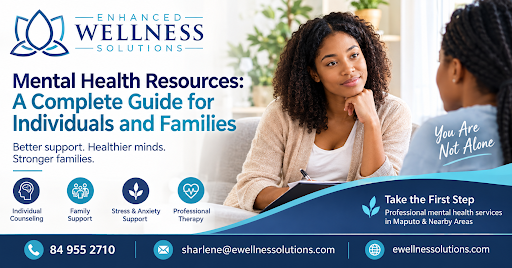
Mental health resources for individuals and families in Maputo span several categories: therapy and psychotherapy with a licensed psychologist, public health and community-based counseling, support groups, resources specific to children and families, workplace support, online mental wellness platforms, and emergency crisis services. Mozambique’s National Health Service has expanded access by placing trained psychiatric technicians in health facilities nationwide, giving families a public option alongside private counseling in Maputo. Enhanced Wellness Solutions provides therapy, psychotherapy, and counseling throughout Maputo and nearby areas, offering one clear, accessible starting point for anyone unsure where to turn.
Figuring out where to find the right mental health support can feel like its own separate challenge, especially with so many different options, therapy, support groups, public clinics, online platforms, all seemingly pointing in different directions. This guide is meant to simplify that search, breaking down what’s actually available to individuals and families in Maputo and how to know which type of support fits your specific situation.
Before getting into specific categories, it’s worth understanding the broader landscape of mental wellness support in Maputo and across Mozambique. The National Programme for Mental Health has worked to integrate mental health care directly into the primary healthcare system, rather than keeping it siloed as a specialized service available only in major cities or private clinics. Psychiatric technicians, trained in both general and child and adolescent mental health, are now based in health facilities across the country’s districts, meaning basic support is more accessible through the public system than it once was, often at little or no direct cost.
That said, private therapy and psychotherapy in Maputo continue to play an important role, particularly for ongoing, specialized care that public facilities may not always be equipped to provide. Understanding both options gives families a fuller picture of what’s realistically available.
Professional therapy remains one of the most direct and structured paths toward mental health support. This category includes several distinct approaches:
Working with a psychologist in Maputo offers a confidential, structured space tailored to your specific circumstances, rather than generic advice that may not fully apply to what you’re experiencing.
For many families, the public health system serves as a practical entry point into mental health care. Health facilities across Mozambique now offer mental health services, generally at minimal or no direct cost, including basic counseling and referrals to more specialized providers when needed. This represents meaningful progress in a country where private counseling in Maputo has historically been financially inaccessible for a large portion of the population.
Community-based support, often organized through religious institutions or local social networks, also plays a genuine role, particularly in providing informal but meaningful emotional support in communities where formal mental wellness resources remain limited.
Support groups offer something distinct from one-on-one psychotherapy: a shared sense of understanding among people navigating similar experiences. Common types include:
While support groups don’t replace professional counseling when it’s needed, they offer real value in reducing isolation and building a sense of shared community.
Parents and caregivers supporting a child’s mental health have several resources worth knowing about:
This matters significantly, since adolescent girls in Mozambique report notably higher rates of anxiety and depression, often alongside limited awareness of what mental illness looks like or how it can be treated.
For working adults, meaningful support sometimes exists closer than expected, right through the workplace. This can include:
Where available, these resources can serve as a lower-barrier first step toward professional counseling in Maputo.
Distance, scheduling constraints, and personal comfort level all shape whether in-person therapy is realistic for someone. Online resources increasingly help fill this gap:
These options work well as a supplement or entry point, though they generally shouldn’t replace professional psychotherapy for more significant concerns.
This section matters more than any other in this guide. If you or someone you know is in immediate danger or experiencing a mental health crisis:
If you’re personally experiencing thoughts of self-harm or suicide, please reach out immediately, whether to emergency services, a trusted person, or a mental health professional. These feelings are treatable, and support is available right now.
With so many options available, a few guiding questions can help clarify your next step:
There’s no single correct path for everyone, and many families use a combination of these resources as circumstances change over time.
Enhanced Wellness Solutions proudly offers therapy, psychotherapy, and counseling throughout Maputo and nearby areas, with a focus on compassionate, confidential, and culturally aware mental wellness support. Whether you’re navigating a personal challenge, supporting a family member, or simply trying to understand your options, our team is here to help you find the right path forward.
Connecting with the right mental health resource shouldn’t feel confusing or out of reach. If you’re unsure where to start, reaching out to a psychologist is often the clearest first step, and Enhanced Wellness Solutions is ready to help guide you from there. Contact us today to schedule a consultation and take the first step toward better mental wellness in Maputo.
1. What mental health resources are available in Maputo? Options include therapy and psychotherapy with a psychologist, public health services through Mozambique’s National Health Service, support groups, family and child-focused resources, workplace programs, and online teletherapy platforms.
2. Are mental health services free in Mozambique? Basic mental health services are available through the public health system at little to no direct cost, though private therapy or counseling in Maputo typically involves a fee.
3. What resources exist specifically for a struggling child? Family therapy, school-based support where available, and helplines like Linha Fala Criança, which offers free, confidential support to youth in Mozambique, are all worth considering.
4. How do I know if I need therapy or if a support group is enough? Persistent or significant challenges generally benefit from professional psychotherapy, while support groups work well as a complement for reducing isolation and connecting with others facing similar experiences.
5. What should I do in a mental health emergency? Contact emergency services immediately, go to the nearest hospital, or reach out to a trusted person. In Mozambique, police can generally be reached at 119 and ambulance services at 117.
Enhanced Wellness Solutions provides therapy, psychotherapy, and counseling throughout Maputo and nearby areas. Contact us today to find the right support for yourself or your family.
This article is intended for general informational purposes and does not replace professional diagnosis or treatment. If you are experiencing a mental health crisis, please contact emergency services or a local hospital immediately.
Contact Us for Your Professional Mental health services in Maputo & Nearby Areas
Company Name: Enhanced Wellness Solutions
Address: Maputo & Nearby Areas
Phone: +258 84 95527 10
Visit Our Website: Click Here
Enhanced Wellness Solutions delivers holistic mental health and wellness services, combining expert care with compassionate support to nurture well-being in individuals and organizations alike.
© Copyright 2026 Enhanced Wellness Solutions – All Rights Reserved.
Enhanced Wellness Solutions
Typically replies within minutes
How can we support you today?
WhatsApp Us
🟢 Online | Privacy policy
Least Discuss