


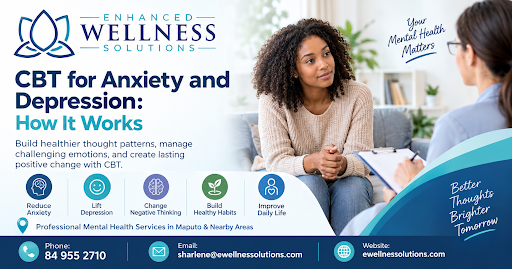
CBT, or cognitive behavioral therapy, treats anxiety and depression by helping you identify unhelpful thoughts and habits, test whether they are accurate, and replace them with more balanced thinking and healthier actions. It is a structured, skills-based therapy delivered by a trained professional, usually over about 8 to 20 weekly sessions. CBT is one of the most widely researched talk therapies, and it helps many people, although results vary and some need extra support. Enhanced Wellness Solutions provides professional mental health services in Maputo and nearby areas, including therapy, psychotherapy, and counseling for individuals and families.
Anxiety and depression can feel isolating. Worry may crowd your thoughts for hours, or low mood may make even simple tasks feel heavy. The good news is that both conditions are well understood and treatable, and talking therapy is one of the most effective ways to get support. In this guide, we explain how CBT works, how it compares with other approaches, what a typical course looks like, and how to find a psychologist in Maputo who suits your needs.
This article is for general information and does not replace professional diagnosis or treatment.
CBT stands for cognitive behavioral therapy. “Cognitive” refers to thoughts and beliefs, while “behavioral” refers to what you do. The therapy is based on the idea that thoughts, emotions, and actions influence each other. When one part of this cycle changes, the others often follow.
For example, if you believe “I always fail,” you may feel hopeless and avoid trying. Avoiding then gives you no chance to prove the belief wrong, so the belief grows stronger. CBT interrupts this pattern by helping you examine the belief and take small, manageable steps that provide new evidence.
Both conditions tend to involve thinking traps and avoidance, which is why CBT fits them well.
Anxiety often includes:
Depression often includes:
CBT targets these patterns directly, which makes it practical and focused. You learn what keeps the problem going, and then you practise ways to loosen its grip.
Your therapist begins by learning about your symptoms, daily life, and goals. Together, you create a simple picture of how your thoughts, feelings, and behaviors connect. This shared understanding gives your therapy direction.
Next, you practise noticing the thoughts that appear when you feel anxious or low. Typical examples include catastrophizing (“this will be a disaster”), mind-reading (“they think I’m useless”), and all-or-nothing thinking (“if it isn’t perfect, it’s a failure”).
Instead of accepting every thought as fact, you evaluate it. What evidence supports it? What evidence does not? What would you tell a friend? The goal is not to think positively at all costs. It is to think more accurately and kindly.
Action is a key part of CBT. For anxiety, you may gradually face feared situations, beginning with easier steps. For depression, you may use behavioral activation, scheduling small activities that bring a sense of enjoyment or achievement.
Short exercises, such as a thought diary or a calming routine, help you apply new skills to real life. Progress usually comes from this practice, not just from the sessions themselves.
Finally, your therapist helps you build a relapse prevention plan, so you know how to respond if symptoms return.
CBT is just one approach within psychotherapy. Different methods suit different people.
Many professionals combine ideas from several approaches. If you are unsure which would suit you, a good psychologist will talk through the options in your first appointment.
Although each person is different, a typical course may look like this:
Many people attend about 8 to 20 weekly sessions, but the right length depends on your needs. Some people feel early relief within a few weeks, while others need more time.
Research on CBT is extensive, and many health organizations commonly recommend it for anxiety disorders and depression. People often value that it gives them tools to use for life, not just short-term relief.
However, it is honest to note some limits. CBT does not work equally well for everyone. It requires effort between sessions. For moderate to severe symptoms, a doctor or psychiatrist may suggest combining therapy with medication. And if one approach is not helping enough, that is not a personal failure. It simply means the plan may need to change.
CBT may be worth exploring if you experience:
It is also worth speaking with a professional if symptoms affect your work, studies, relationships, or daily functioning.
Therapy works best alongside healthy daily habits. Consider these supportive steps for your mental wellness in Maputo and beyond:
These habits are not a replacement for professional care, but they can strengthen it.
Finding the right professional matters. When comparing options, ask:
A strong working relationship is one of the best predictors of good therapy outcomes, so trust your sense of fit.
Therapy is not an emergency service. If you or someone you know is in immediate danger or thinking about self-harm, contact emergency services or go to the nearest hospital right away, and stay with a trusted person. In Mozambique, police can generally be reached at 119 and ambulance services at 117, though you should confirm current numbers locally.
Enhanced Wellness Solutions is a professional mental health service in Maputo. We provide therapy, psychotherapy, and counseling for individuals and families in Maputo and nearby areas, supporting people who are dealing with anxiety, low mood, stress, and life transitions.
Our approach is simple: listen carefully, explain clearly, and work with you toward realistic goals in a confidential and respectful setting. At your first appointment, we discuss your concerns and talk through the type of support that may suit you best. If you are searching for a psychologist, therapy, or counseling in Maputo, we would be glad to help. Contact Enhanced Wellness Solutions today to ask your questions or book an appointment.
1. How does CBT work for anxiety and depression?
CBT helps you notice unhelpful thoughts and behaviors, test them, and practise healthier responses, which gradually reduces anxiety and improves mood.
2. How long does CBT take?
Many people attend about 8 to 20 weekly sessions, depending on symptoms, goals, and how often skills are practised.
3. What is the difference between therapy, psychotherapy, and counseling?
The terms overlap. Counseling often focuses on current issues and support, while psychotherapy usually explores patterns in more depth. Many professionals blend both.
4. When should I see a psychologist in Maputo?
Consider it if worry or low mood lasts for weeks, affects daily life, or feels hard to manage alone.
5. Does Enhanced Wellness Solutions provide therapy and counseling in Maputo?
Yes. Enhanced Wellness Solutions provides therapy, psychotherapy, and counseling for individuals and families in Maputo and nearby areas.
Company Name: Enhanced Wellness Solutions
Address: Maputo & Nearby Areas
Phone: +258 84 95527 10
Visit Our Website: Click Here
Google Business Profile : Here
Enhanced Wellness Solutions delivers holistic mental health and wellness services, combining expert care with compassionate support to nurture well-being in individuals and organizations alike.
© Copyright 2026 Enhanced Wellness Solutions – All Rights Reserved.
Enhanced Wellness Solutions
Typically replies within minutes
How can we support you today?
WhatsApp Us
🟢 Online | Privacy policy
Least Discuss